
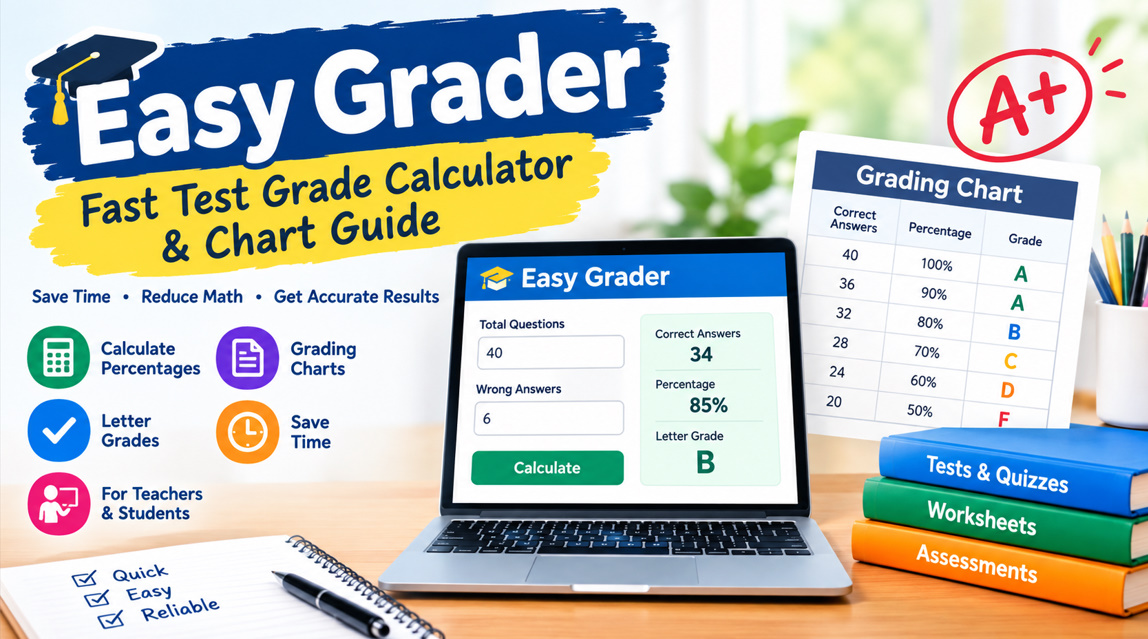
What Is an Easy Grader?
An Easy Grader is a simple grading calculator designed to turn the number of correct or incorrect answers into a percentage and, when supported, a letter grade. Instead of performing the same percentage calculation repeatedly, teachers, tutors, and students can use an easy grade calculator to make scoring faster and more consistent.
The basic idea is straightforward: enter the total number of questions and the number answered incorrectly or correctly. The calculator determines the resulting score. This makes an EZ grader particularly useful for quizzes, tests, worksheets, practice assessments, and other activities where questions have equal value.
- Simple grading calculator
- Fast score calculation
- Percentage conversion
- Letter-grade support
- Test score calculator
- Quiz grading tool
- Teacher-friendly design
- Beginner-friendly interface
How Does an Easy Grader Work?
An Easy Grader generally uses a basic percentage formula: the number of correct answers is divided by the total number of questions and multiplied by 100. For example, a student who answers 45 out of 50 questions correctly receives a score of 90%. The calculator performs this arithmetic automatically.
Many EZ Grader tools can also display a complete grading chart. A chart shows how every possible number of mistakes affects the final percentage, making it practical when teachers are grading multiple papers from the same assessment.
- Enter total questions
- Count incorrect answers
- Calculate correct answers
- Convert scores to percentages
- Display possible grades
- Check letter grades
- Reduce manual arithmetic
- Speed up paper grading
Why Teachers Use an Easy Grader
Teachers often grade several quizzes or tests containing the same number of questions. Calculating each percentage manually can become repetitive, especially when moving through a large stack of papers. An easy grader simplifies this process by applying the same calculation consistently to every student score.
A digital grading calculator can also reduce common arithmetic mistakes. When teachers use a predefined grading chart, they can quickly identify the percentage associated with a particular number of incorrect answers. This can make routine classroom assessment more efficient without requiring complicated software.
- Saves grading time
- Reduces arithmetic errors
- Supports repeated grading
- Simplifies score checking
- Helps maintain consistency
- Works for classroom tests
- Useful for quick quizzes
- Reduces repetitive calculations
Easy Grader for Quizzes and Tests
An Easy Grader works especially well for assessments where each question carries the same value. Multiple-choice quizzes, true-or-false tests, matching activities, vocabulary checks, and many practice assessments can be scored using a straightforward correct-versus-total calculation.
The tool is also useful across different subjects because the underlying mathematics does not depend on the topic. Whether the assessment covers mathematics, science, history, language arts, or another subject, an online grade calculator can convert the raw result into a percentage when the scoring structure is equal.
- Multiple-choice quizzes
- True-or-false tests
- Matching exercises
- Vocabulary assessments
- Practice exams
- Classroom worksheets
- Short unit tests
- Objective assessments
Easy Grader and Grading Charts
One useful feature associated with an EZ grader is the grading chart. Instead of calculating every student’s percentage separately, a teacher can reference a table showing the score associated with each possible number of wrong answers. This is especially convenient when an entire class completes the same test.
For example, on a 25-question assessment, every missed question represents four percentage points when all questions have equal value. A grading chart can display these results in advance, allowing teachers to identify scores quickly while marking papers.
- Complete score tables
- Wrong-answer lookup
- Correct-answer lookup
- Percentage references
- Faster paper marking
- Consistent calculations
- Easy score comparison
- Convenient classroom reference
Benefits of Using an Online Easy Grader
An online Easy Grader can make routine score calculations more convenient because it handles the arithmetic automatically. Many modern grading calculators are designed for browsers and can be used on common devices, making them practical for teachers who move between classrooms, desks, or study areas.
Another advantage is simplicity. Users generally do not need advanced spreadsheet skills to calculate a basic test percentage. By entering a few numbers, they can receive a result quickly. Some calculators also provide options such as customizable grading scales, decimal scores, or partial-point calculations.
- Quick calculations
- Easy browser access
- Minimal data entry
- No advanced math required
- Useful on multiple devices
- Supports grading workflows
- Clear score presentation
- Convenient for busy teachers
Easy Grader for Students, Tutors, and Parents
Although teachers are common users, an Easy Grader can also help students understand assessment results. A student can use a score calculator to determine what percentage a particular number of correct answers represents. This can make raw marks easier to interpret and understand.
Tutors and parents may also find a simple grade calculator useful when reviewing practice tests or worksheets. However, the final interpretation of a grade should always follow the grading policy used by the relevant school, teacher, course, or institution rather than relying solely on a generic calculator.
- Students checking scores
- Tutors reviewing practice work
- Parents understanding percentages
- Homeschool assessment support
- Practice-test grading
- Score interpretation
- Percentage calculation
- Academic progress review
How to Get Accurate Results with an Easy Grader
Accuracy begins with correct input. Before calculating a grade, confirm the total number of questions and carefully count the student’s correct or incorrect answers. If questions have different point values, a simple question-count calculator may not accurately represent the assessment unless it supports point-based scoring.
It is also important to understand the grading scale. A percentage and a letter grade are not always interchangeable because schools can use different cutoff points. For reliable results, use the grading policy provided by the teacher or institution and configure a customizable calculator when appropriate.
- Verify total questions
- Count answers carefully
- Check the answer key
- Confirm scoring rules
- Review percentage results
- Check letter-grade cutoffs
- Account for partial credit
- Follow school policies