
What Is a VIT GPA Calculator?
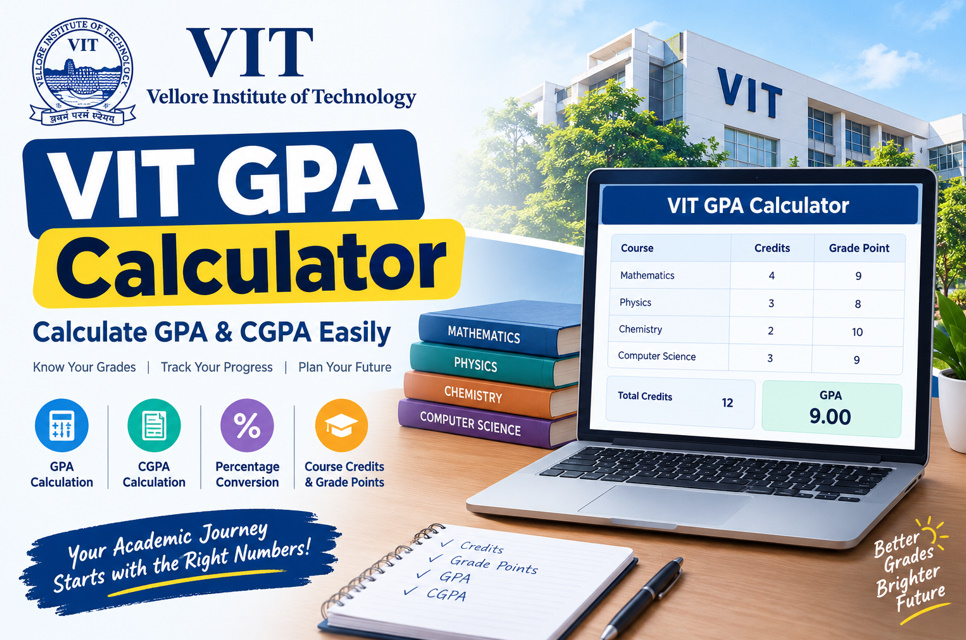
A VIT GPA calculator is a simple academic tool that helps students calculate their Grade Point Average using course credits and grade points. VIT defines GPA as a quantitative measure of semester performance based on the weighted average of grade points earned in registered courses.
Because every course may have a different credit value, a basic average of grades does not accurately represent GPA. A VIT GPA calculator applies the credit-weighted method automatically, helping students estimate their semester performance, understand academic progress, and reduce manual calculation errors.
- Calculates semester GPA
- Uses course credits
- Uses grade points
- Applies weighted averages
- Saves calculation time
- Reduces arithmetic errors
- Tracks academic performance
- Supports study planning
How Does the VIT GPA Formula Work?
The VIT GPA formula is based on the relationship between course credits and grade points. For each registered course, multiply its credit value by the grade point earned. Add all the resulting credit-point values and divide the total by the applicable credits registered during that semester.
The formula can be represented as GPA = Σ(Credit × Grade Point) ÷ ΣCredits. This means a higher-credit course has a greater mathematical effect on the final GPA than a lower-credit course. Understanding this calculation makes it easier to verify a result from a VIT GPA calculator.
- Multiply credits by grade points
- Add weighted values
- Calculate total credits
- Divide weighted points
- Check every course
- Verify credit values
- Review the final GPA
- Round the result correctly
Understanding VIT Grade Points
Grade points are numerical values assigned to letter grades and are used in the GPA calculation. Instead of directly averaging examination marks, the GPA calculation uses the grade points associated with the grades earned in applicable courses. This creates a consistent method for measuring academic performance across different subjects.
Students should enter the grades shown on their official academic record when using a VIT GPA calculator. The grading framework and course-specific rules can vary according to applicable academic regulations, so students should avoid estimating a grade from marks unless the relevant grading method is clearly known.
- Check awarded grades
- Use correct grade points
- Review your grade sheet
- Verify course details
- Check applicable regulations
- Avoid guessing grades
- Confirm unusual courses
- Keep academic records
How to Calculate VIT GPA Manually
Calculating VIT GPA manually requires three main pieces of information: course name, course credits, and grade point. Start by multiplying the credits of each course by its corresponding grade point. Then add all the resulting values and divide their total by the sum of the applicable course credits.
For example, consider three courses carrying 4, 3, and 2 credits with grade points of 9, 8, and 10. The calculation is (4×9 + 3×8 + 2×10) ÷ (4+3+2). This gives 82 ÷ 9 = 9.11, demonstrating how credit weighting affects the semester GPA.
- List your courses
- Record course credits
- Record grade points
- Multiply each pair
- Add credit points
- Add total credits
- Divide the totals
- Round to two decimals
VIT GPA vs CGPA: What Is the Difference?
GPA and CGPA measure academic performance over different periods. GPA represents performance for the courses registered during a particular semester, while CGPA represents overall performance from the beginning of the programme through the relevant semester. VIT calculates both using a weighted approach based on credits and grade points.
A VIT GPA calculator therefore focuses on one semester, while a VIT CGPA calculator considers applicable courses across multiple semesters. Understanding the difference is important when checking a grade sheet, preparing academic applications, monitoring progress, or reviewing cumulative university performance.
- GPA is semester-based
- CGPA is cumulative
- GPA uses course credits
- CGPA uses cumulative courses
- Both use grade points
- GPA changes by semester
- CGPA builds over time
- Check your official record
Why Course Credits Matter in VIT GPA
Course credits determine how strongly each subject contributes to the GPA. When a grade point is multiplied by the course’s credits, a higher-credit subject produces a larger weighted value than a lower-credit subject with the same grade point. This is why credit information must be entered accurately into a GPA calculator.
Students should not calculate GPA by simply adding grade points and dividing by the number of subjects. That method treats every course equally, whereas VIT’s published formula gives each registered course an influence based on its credit value. Correct credit information is therefore essential for an accurate calculation.
- Credits determine course weight
- Higher credits have greater influence
- Lower credits have less influence
- Verify registered credits
- Include applicable courses
- Avoid duplicate courses
- Check credit totals
- Recalculate after corrections
How to Use a VIT GPA Calculator
Using a VIT GPA calculator is straightforward. Enter each applicable course, provide its credit value, and select or enter the corresponding grade point. The calculator then multiplies the credit and grade-point values, adds them together, and divides by the relevant total credits.
Always check the information before relying on the calculated result. A missing course, incorrect credit value, or wrong grade point can change your GPA. A calculator is useful for estimation and academic planning, while the GPA recorded on the official grade sheet remains the formal academic result.
- Enter every applicable course
- Add course credits
- Enter grade points
- Check each entry
- Verify total credits
- Review the formula
- Save the calculation
- Compare with your record
VIT GPA, CGPA and Percentage Conversion
VIT’s published FFCS regulations state that the percentage equivalent of CGPA is calculated using CGPA × 10. For example, a CGPA of 8.75 corresponds to an equivalent percentage of 87.5 under that stated conversion method. Students should distinguish this equivalent percentage from their original GPA or CGPA.
The same regulations state that GPA and CGPA are indicated by rounding the actual values to two decimal places. When a percentage equivalent or official certificate is required for an application, students should follow the current academic requirements and use their official academic documentation.
- GPA measures semester performance
- CGPA measures cumulative performance
- Percentage is an equivalent
- Use the stated conversion rule
- Check CGPA carefully
- Review decimal rounding
- Keep your grade sheet
- Follow official requirements
Benefits of Using a VIT GPA Calculator
A VIT GPA calculator simplifies a calculation that can otherwise require several multiplication and addition steps. Students can quickly enter course credits and grade points to estimate their GPA. This makes the tool useful for checking semester performance, maintaining academic records, and understanding the effect of credit weighting.
A calculator can also help students identify input mistakes before reviewing their academic results. However, the tool only calculates the information provided to it. It cannot determine grades or replace the official GPA and CGPA reported in university academic records.
- Saves time
- Simplifies calculations
- Reduces arithmetic mistakes
- Explains credit weighting
- Helps monitor GPA
- Supports academic planning
- Makes results easier to check
- Useful for semester tracking